“A study that sets sail to explore a more traditional Customer Journey Mapping (CJM) with the same focus on New Product Development and Named Entity Recognition (NER) very quickly runs aground. Fortunately, it does so barely out of the harbour.”
This narrative says nothing of the chances of success for subsequent journeys. Empirically, a failure, even early on, has ramifications for the future. Professional journeys do not just end there, hopefully. However, it seems almost fortunate to be in a position to resume a project after it fails initially. Then again, the adage “LUCK is Labouring Under Controlled Knowledge” most likely applies here.
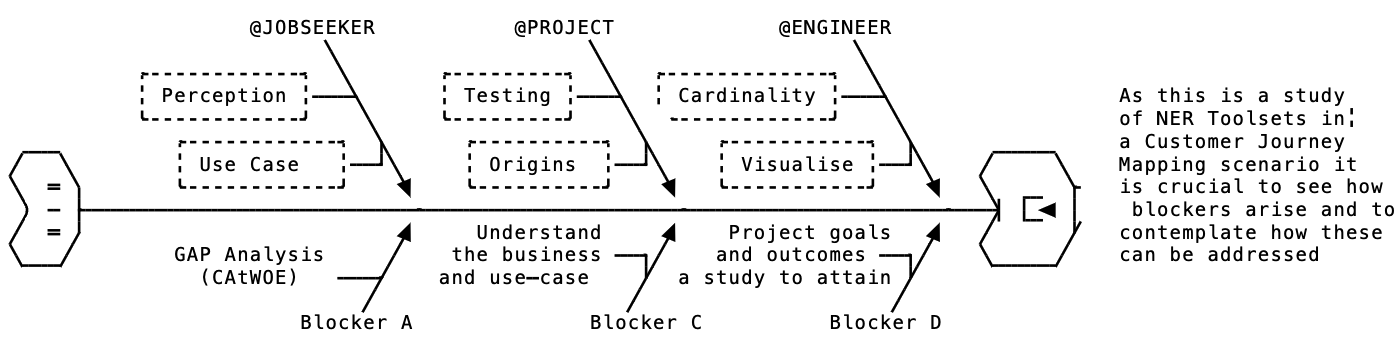
Evidence from this study shows that the risk factors for failure were identified. This circumstance did occur, and the project experienced the consequences of the aforementioned risk. The Figure 2 depicts a fishbone diagram exploring Blockers in the context of Assertions, Context and Deferred items
Analysing ABCD, we expect this general alignment, and so we can enforce quality by establishing tests of correlation (as a stretch goal for future iterations).

Note: As a stretch goal for future iterations….
can resume by navigating the changes arising due to concerns that caused it to falter.
However, The probability of success does not change because of what we do next; this depicts the sweet spot of Customer Journey Mapping (CJM). We walk away from a gravity problem and return when better resourced. We assume risk based on known principles a priori and walk away a posteriori. The ability to return indicates that a past attempt accurately captured risk. Doing something twice does not make us more successful, and is expanded upon below.
Consider then our definition of success. CATDOG premises that the target systems do not change any C-A-T-D-O-G dimension. “The system does not make me (succeed).” It can raise the chance of personal or professional success. It can serve to punish (judiciary). Subsequently, systems cannot fail people in the same sense we say, “The system failed us!” In this event, CATDOG supports cognitive reframing.
Also, CATDOG trains focus on the outcomes of the group’s beliefs (in Gestalt) and outer or external constraints (as zeitgeist). Systems exist to support a worldview; are these closed systems with restricted access or closed-looped with open feedback? Journey Mapping leans on the second, asking for feedback, and this feedback is often visible.
CATDOG is an iterative process. It links the ‘interconnectedness of ideation’ and the interconnectedness of systems by ideation. Journey Mapping (JM), we posit, measures the clarity of ideation. JM disregards everything outside the system’s periphery and measures a system step in isolation, i.e. excluding other systems in these aspects that call for human attention.
An example of interconnectedness was the `ABCD of Design`, which appeared in 22 documents (notes and project updates). Google’s Notebook LM platform helped build a narrative from these. Additionally, the AI built a near-precise description of the entire study’s key points with access to just the notes that reference or reflect on ABCD. Audio will be available on the associated website.
Doing something twice does not make us any more successful.
We view the rise of AI through the perspective of how database technology became accessible as computing costs decreased, processing power improved, and the gap in training resources narrowed. Small businesses began developing systems in-house, creating new opportunities. Should we anticipate similar developments, considering the high availability and widespread nature of AI, machine learning (ML), and natural language processing (NLP) solutions? If so, why?
On Finding, Fitting, and Forming
This heuristic, taken from the context of the employment journey, applies. It highlights a problem: these might be 3 distinct steps or stages. Named Entity Recognition (NER) is an excellent fit for the first:
Finding skill tokens that match our skill set.
Matching our CV to a job description.
Improving our search parameters.
NER can help determine the gaps. However, it takes action to fill them and ensure a Fit.
Logically, after establishing a match, we might correlate for fit. Similarly, we need a clear picture of our current skills and estimated business needs to Form a projection. Data on national and global skills gaps and shortages only relate to Fitting. Consequently, any data on changing course midway is always unreliable. Staying in your lane is the pragmatic approach. So on to building the journey first find, then fit, and last form. Journey mapping should encompass these in turn.
The original scoping of the project was complex.
Adopting the ABCD process clarified near-reach goals versus stretch goals. ABCD also offered insight into interpreting the value of reproducibility and observability from a design standpoint. Reproducibility holds that the past premises hold in the context of the current development cycle.