A Note on Systems Modelling
We paint systems as box-like in a finite physical space. The box scales up as a room with people producing items and processes. The room has hinged windows that, when opened, reveal a static picture of the world. That static picture, in a business sense, is the customer abstraction; in the engineering sense, this abstraction is a persona. This abstraction may represent large language machine-learning training models.
Whether a systems intervention is Hard or Soft, systems coexist outside the imagination. Although designers mould these design-decisions around abstraction layers, they still have a tangible impact regarding people-process resources (financial cost) and product-service transformations (opportunity cost). There is an interconnectedness between systems. Senge (2016)
Every step in a transformation journey acknowledges this real-world impact. Systems design choices have a real impact. Tools like CATDOG analysis offer a route to understand, reframe and resume. In the context of an Employment journey, finding, fitting and forming respectively. It helps uncover why we participate and where (as Customer, Owner, Actor-agent and combinations) and how. Consider the Gestalt; there may be several approaches. Acting on anchored beliefs in the context of our agency, and differentiating these from gravity problems.
Systems often present areas for professional learning and achievement, as an aspect of group endeavour. Systems enable a state transition or change within which their underlying transformation occurs. (In soft systems, transformations consider human interventions). We stress that CATDOG explicitly excludes a transformation on any system’s parts. The system transforms neither Customer, Agency, Domain, Owner, nor Gestalt. No assumptions are made about the zeitgeist as this is intangible and without scope.
We conclude that system change comes from within the system (Senge, P.,2023), which we assert stems from changes in our analysis of the parts, and motivation and successes may be affected by the zeitgeist.
Customer (C) changes arise from the perceived accessibility of new technology. Actor (A) changes are indirectly affected by many factors, including breakthrough technologies like the pervasive impact of Artificial Intelligence (AI), causing organisational drifts in staffing and governance, and focusing on delivering tangible value beyond the hype. (Gemini, 2025) Transformation (T) changes occur within resourcing. Domain of knowledge (D) can pull at a business’s marketing mix (Product, Platforms, People, Place, Pricing) choice. Ownership changes will affect decisions around resourcing levels. Gestalt suggests that the future success of a system relies on past performance.
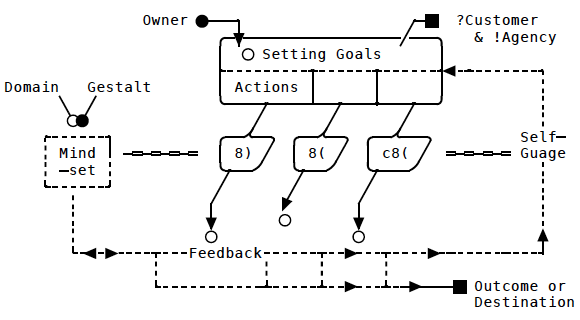
Adopting the convention of Customer Journey Mapping (CJM)as depicting steps towards a goal, as described by Gibbons (2018).