Consider the @PERSONAS
Outline: Exploration Deploying CATDOG
A quick overview of the exploration for this project1 follows.
Consider the two parts, of the sketch in Figure 1 above the Transformation fold, which establishes the Engineering functions relationship to the customer @PROJECT, and the Owner @PROGRAM.
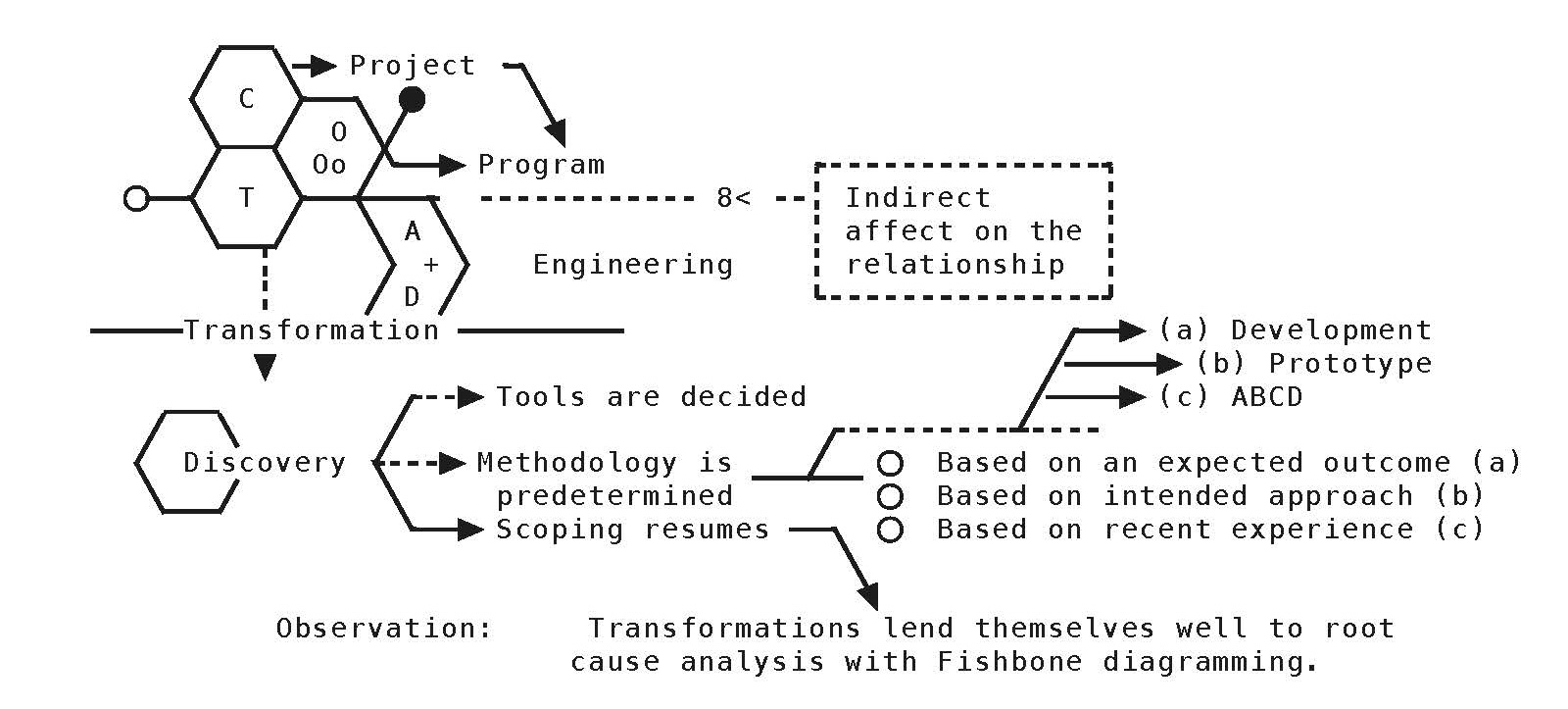
Overview: Examining the Exploration Using a CATDOG
Below this fold, observe that a Discovery process drives the underlying transformation. We soon establish that the tooling of the transformation is predetermined, with the risk that this creates a dependency or limits idea development. Any subsequent changes in tooling will affect the timelines and quality of the output.
It is imperative to set expectations upfront about the impact of changes. Alternatively, we need to retain the ability to rescope, as the premise was
Additionally, methodology was predetermined from earlier exploration and may have overspill from ongoing other projects. Overspill refers to catchall behavioural phenomena like inattentive blindness, which is the human capacity to focus narrowly on stimuli and effectively be blind to other events within the frame.
‘CATDOG’ can uncover significant risks. For this core discovery exercise, @ENGINEERING works with @PROJECT rather than directly with @PROGRAM. Consequently, a risk that the solutions delivered by this transformation will be over-engineered. The project team must be specific about the nature and timing of deliverables; agile practices may reduce the risk over iterations.
As with any learning activity, this is an ongoing process that engineers will iterate upon over their professional careers. One valuable lesson here is the risk surrounding methodology. The solutions require extra resources or expertise. Hence, there are budgeting and cost management pressures. These are PROJECT costs in this operational model.
Footnotes
Determined through a CATDOG process!↩︎