Engineering practice receives ongoing attention and public criticism in publications.1 We premise that this deters investment into new product development (NPD) from Small and medium-sized enterprises (SME) 2 and micro organisations. Given the advent of new technology emerging with free or tiered and low-cost access, plus an abundantly skilled workforce, the opportunity lost is conceivably high. To explore the extent to which engineering is culpable, we empirically explore what is involved in developing successful systems.
The study explores themes of ideation and risk around the opportunities that arise due to lowered barriers to access from the engineering practice perspectives on applying emerging technology to a business use case. It emphasises value-adding through iterative development and as a learning process. The focus is on exploring Named Entity Recognition (NER) in the context of New Product Development (NPD) within the Customer Journey Mapping (CJM) knowledge domain.3
The project takes on the mantle of Engineering and is characterised as a thought experiment analysing complex problems that benefit from proof of concept and prototyping. It addresses issues that arise when working with opportunities perceived as high strategic value. We aim to support a worldview in which Engineers fully engage their skills and abilities by thinking in design terms to address and resolve problems. This view has traction, 4 5 6 celebrating a centenary within the engineering zeitgeist. 7
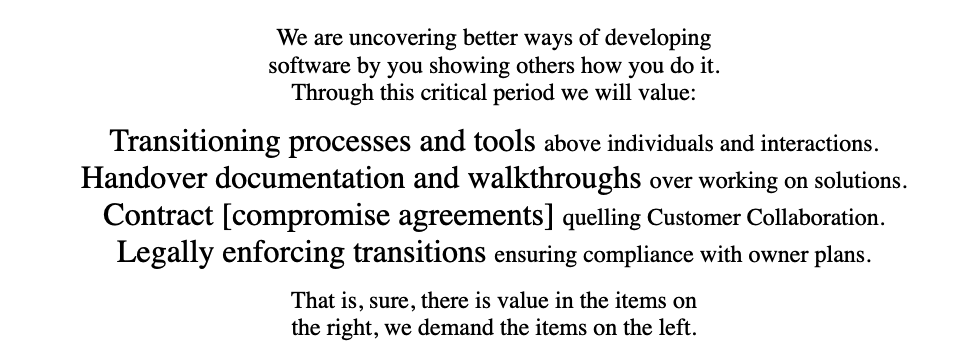
Systems Thinking (ST) can be reapplied or adapted to new topics. Businesses in crisis may limit engineering practices by forging rigid chains of command, resulting in actions that contradict the principles of engineering best practices in challenging times of transition. Figure 1 posits a cautionary interpretation of the Agile Manifesto.
We seek to realign ourselves with the Agile Manifesto.
