Finalised CATDOG (needs a consolidated write-up focused on methods is still underway)
Facets C A O are developed as Personas
For CATDOG analysis, I created a Joplin template
Testing with spaCy
Configured rstudio workstations with
sparklyrto bypass in-memory processingScraped emails
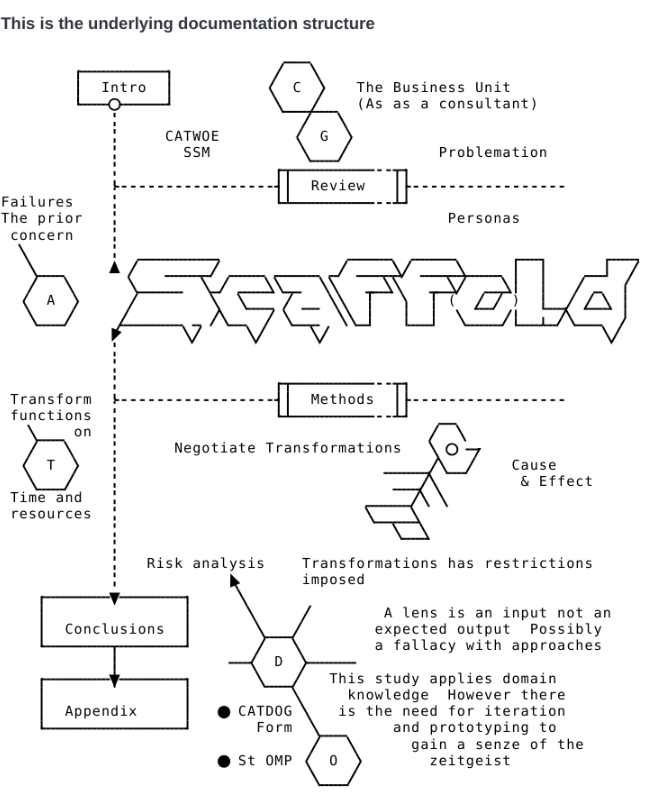
- Presumably, we must follow the IMRD format: Introduction, Methods, Results, Discussion.
- Documenting Methods is still underway
| Action | Blocked By ~ Dependency |
Created | Due |
|---|---|---|---|
| Reproducibility | Project Persona | Week 1 | Week 7 |
Isolate Meta Goals |
- | Week 8 | Week 14 |
| NLTK/spaCy | Week 9 | Week 14 |
Reflecting on a switch from GQM to GROW as a goal-setting mnemonic:
An Explorative Approach (addendum)
Noting how exploration has a cost. It feels like it detracts from the course of a project. In documenting it, we can hope to find value. Otherwise, if an exploration is not immediately documented then when an unforseen problem arises by having the documentation in place we established a fallback and avert a total disaster. Thus minimises the impact of a failure. However, there is a case for managing notes better.
Tangential to this, I discovered notes that I had forgotten; it is in a miss-titled section of notes as it was quickly put together as part of the REPRODUCIBILITY path in this project. (Bringing up past notes from the unsuccessful project). and these include possibly valuable insights like the fishbone exploration of Blockers in the context of ABCDs off Design (below). We find a correlation between the blocker origin (Assertion, Contextual, Deferred) and the persona.
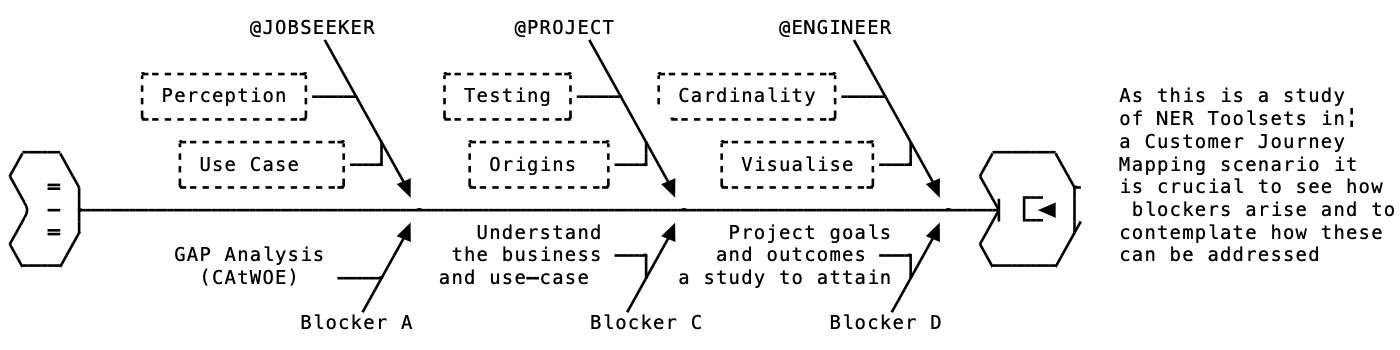
The above pattern suggests that in this scenario teams can develop Goals and Metrics around a few centrally themed questions explored by CATDOG. Further iterations of this design process can lead to insights into how to manage Goal Question Metrics (GQM) at scale. Recall for now we reverted to the GROW mnemonic.